Water mitigation in Hickory Creek, TX
This page covers water mitigation in Hickory Creek, Texas. One call connects you with an independent restoration company for the cleanup and drying.
Calls connect to an independent restoration company.
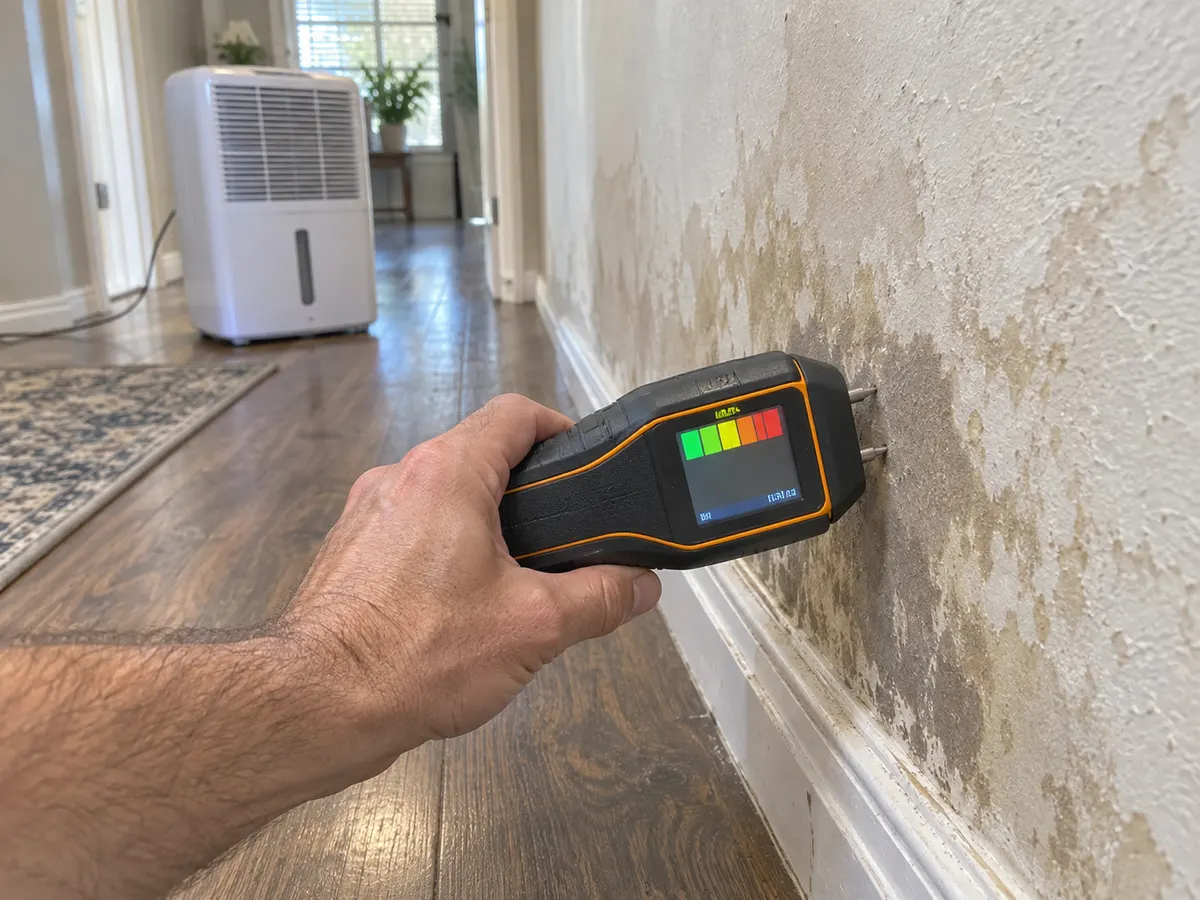
Water mitigation for Hickory Creek homes
Water mitigation is about limiting damage, and the first step is knowing how far the water went. The IICRC describes the initial response as a safety survey, confirming the source, mapping water migration, deciding the water category and setting drying goals (IICRC). In Hickory Creek, as anywhere, water that runs under baseboards and into wall cavities often travels farther than it looks.
For a clean supply-line leak, the crew can go straight to drying. For Category 2 or 3 water, the IICRC says remediation comes before restorative drying, with containment and protective gear (IICRC). The EPA’s humidity target, below 60 percent and ideally 30 to 50 percent, applies while the house dries (EPA).
If the water is from a clean source, start with water damage restoration in Hickory Creek. The Dallas-area water mitigation guide covers the process in more depth. Other Hickory Creek pages: sewage cleanup, crawl space water removal, flood restoration, emergency water removal, water extraction and water damage cleanup.
How water mitigation works
- Safety surveyThe crew checks the site for hazards before work begins.
- Verify the sourceThe leak or entry point is confirmed and stopped.
- Map the waterMoisture meters show how far water migrated into walls and floors.
- Set drying goalsReadings from unaffected materials set the target for dry.
- Extract and dryWater comes out and equipment runs until the goals are met.
Hickory Creek details
What matters in Hickory Creek
The IICRC notes that the age of the structure and its history of previous water damage are part of the information a restorer gathers (IICRC). In Hickory Creek, the median home was built in 2008, 35% of homes date from the 1990s or 2000s and 13% predate 1980 (U.S. Census Bureau, ACS 2020-2024). Much of Hickory Creek is new construction. 45% of housing units were built in 2010 or later, and the median year built is 2008 (U.S. Census Bureau, ACS 2020-2024).
Housing in Hickory Creek is newer than the typical Denton County town on this site: a median year built of 2008, against 2001 for the middle of the other 6 (U.S. Census Bureau, ACS 2020-2024). Of the 33 towns covered here, Hickory Creek ranks 28th oldest by median year built. 35% of homes here were built in the 1990s or 2000s (U.S. Census Bureau, ACS 2020-2024).
Nearby water mitigation pages: Double Oak (5 miles), Flower Mound (7 miles) and The Colony (8 miles).
- Population5,611 residents and 2,036 housing units (U.S. Census Bureau, ACS 2020-2024).
- Housing ageMedian year built 2008; 13% built before 1980 (U.S. Census Bureau, ACS 2020-2024).
- Home types82% detached houses, 12% in multi-unit buildings, 4% mobile homes (U.S. Census Bureau, ACS 2020-2024).
- Owners80% of occupied homes are owner-occupied; median owner home value $507,200 (U.S. Census Bureau, ACS 2020-2024).
- Utility contactHickory Creek Public Works can be reached at 469-576-5094, Monday to Thursday 6 am to 4 pm (Hickory Creek Public Works).
- CountyHickory Creek is in Denton County. Hickory Creek covers 4.9 square miles of land (U.S. Census Gazetteer).
- ZIP codesThis page covers 75065.
Water mitigation questions
What is the difference between water mitigation and restoration?
Mitigation is the work that stops damage from spreading: inspection, water removal and drying. Restoration can also include rebuilding. The IICRC describes the first steps as verifying the source, identifying water migration and setting drying goals (IICRC).
Is this a restoration company in Hickory Creek?
No. 214 Damage is a referral service. Your call connects you with an independent restoration company that serves Hickory Creek.
Water mitigation in Hickory Creek
One call connects you with an independent restoration company.
Call (844) 690-4312